Sodomy
In Dante Alighieri's moral geography, sodomy occupies a precise and severe position. It is not a sin of incontinence, like lust or gluttony, but an act of violence — specifically, violence against God and nature. Virgil explains this to Dante in Canto XI of the Inferno, as they pause beside the tomb of Pope Anastasius to let the stench of the abyss subside. Violence, Virgil teaches, can be done to God in three ways: by denying and blaspheming Him in the heart, by disdaining Nature and her bounty, and by disdaining Art, which follows Nature as the disciple follows the master. Sodomy falls under the second category: it is a direct violation of the natural order that God has established, and for this reason, those who committed it are punished in the smallest and most intense of the three rounds of the seventh circle, sealed with the signet of Sodom and Cahors.
Location and Landscape of Punishment
The third round of the seventh circle is a vast, barren plain of sand, described in Canto XIV as arid and thick, rejecting every plant. The dolorous forest of the suicides surrounds it like a garland, and the river of blood encloses that. The sand itself is scorching, and over it falls an eternal rain of dilated flakes of fire, descending like snow on an Alpine peak without wind. Dante compares the sight to Alexander the Great's encounter with falling flames in India, where his soldiers trampled the soil to extinguish the single vapors. Here, the heat is unceasing, and the sand is set ablaze like tinder beneath a steel, doubling the torment. The souls condemned to this plain are naked, and they move in three distinct postures: some lie supine on the ground, some sit drawn up together, and others — the most numerous — walk continually. All of them weep miserably, and their hands are in constant motion, shaking away the fresh gleeds that land on their bodies. The dance of their miserable hands, now here, now there, is without repose.
The Contrapasso: The Logic of the Punishment
The punishment of the sodomites operates on the principle of contrapasso, the law of symbolic retaliation that governs all of Dante's Hell. Their sin was a rejection of the natural, generative order — a turning away from the divinely ordained purpose of human sexuality and toward a sterile, self-consuming desire. The burning sand and rain of fire mirror the heat of their unnatural passion, but without any possibility of fruition or rest. The incessant motion of the walking souls, who never cease their movement, reflects the restlessness of a desire that could never be satisfied. The fire that falls on them is not merely punitive but also revelatory: it exposes the inner aridity of a life that had turned from God's creation. Virgil's discourse in Canto XI makes this explicit: the usurer, who disdains Nature and her follower Art by putting his hope elsewhere, is punished alongside the sodomites in the same round, for both offenses are forms of violence against the natural order that God has instituted for human life and advancement.
The Inhabitants: Brunetto Latini and the Company of Scholars
The most famous inhabitant of this circle is Brunetto Latini, Dante's beloved teacher and mentor, whom the pilgrim encounters in Canto XV. Brunetto is among those who walk along the sand, and he recognizes Dante by the hem of his garment. Their meeting is one of the most poignant in the entire Inferno, filled with affection and mutual respect. Brunetto walks alongside Dante, keeping to the bank of the river that protects them from the fire, and he speaks of Dante's future, prophesying his exile and the enmity of the Florentines. He tells Dante to follow his star, for he cannot fail of a glorious port, and he warns him against the blind, avaricious, envious, and proud people of Florence. Brunetto's presence here is a shock to the reader, for he was a man of great learning and civic virtue, a notary, a philosopher, and the author of the "Tesoro." Yet Dante places him among the sodomites, and Brunetto himself does not deny the sin. He names others in his company: Priscian, the grammarian; Francis of Accorso, a jurist; and a bishop who was transferred from the Arno to the Bacchiglione. All were clerks and men of letters, tainted with the same sin. The scene is remarkable for its tenderness: Dante speaks of the "dear and good paternal image" of Brunetto, who taught him "how a man becomes eternal," and he promises to keep Brunetto's prophecy in his heart, to be glossed by Beatrice when he reaches her.
The Encounter with the Three Florentines
In Canto XVI, Dante encounters three more souls from this circle: Guidoguerra, Tegghiaio Aldobrandi, and Jacopo Rusticucci. They approach running, their bodies scarred by the flames, and they form a wheel, like naked and oiled wrestlers, to speak with him. They are all Florentines, and they ask Dante whether valor and courtesy still dwell in their city. Dante's response is a bitter lament: the new inhabitants and the sudden gains have engendered pride and extravagance in Florence, so that she weeps already. The three souls, satisfied with his answer, ask him to speak of them when he returns to the world, and then they break their wheel and flee with the speed of wings. Their presence here underscores the theme of civic decay that runs through the Inferno: these were men of noble birth and honorable deeds, yet their private sin has condemned them to this torment, and their city, once home to such virtue, has fallen into corruption.
The Broader Context: Sodomy and the Structure of the Seventh Circle
Sodomy is the third and innermost round of the seventh circle, which punishes the violent. The first round holds those who were violent against their neighbors — tyrants, murderers, and plunderers — who are immersed in the boiling river of Phlegethon, guarded by Centaurs. The second round holds those who were violent against themselves — suicides and squanderers — who are transformed into gnarled, thorny trees in the Wood of Thorns, fed upon by Harpies. The third round, the smallest and most intense, holds those who were violent against God, Nature, and Art. This includes not only sodomites but also blasphemers like Capaneus, who lies on the sand defiantly, and usurers, who sit on the edge of the plain, their eyes fixed on the pouches hanging from their necks that bear their family crests. The three rounds together form a complete taxonomy of violence, and sodomy, as a violation of the natural order, is placed at the deepest point, closest to the abyss of Malebolge.
The Purgatorial Counterpart: Purification of the Lustful
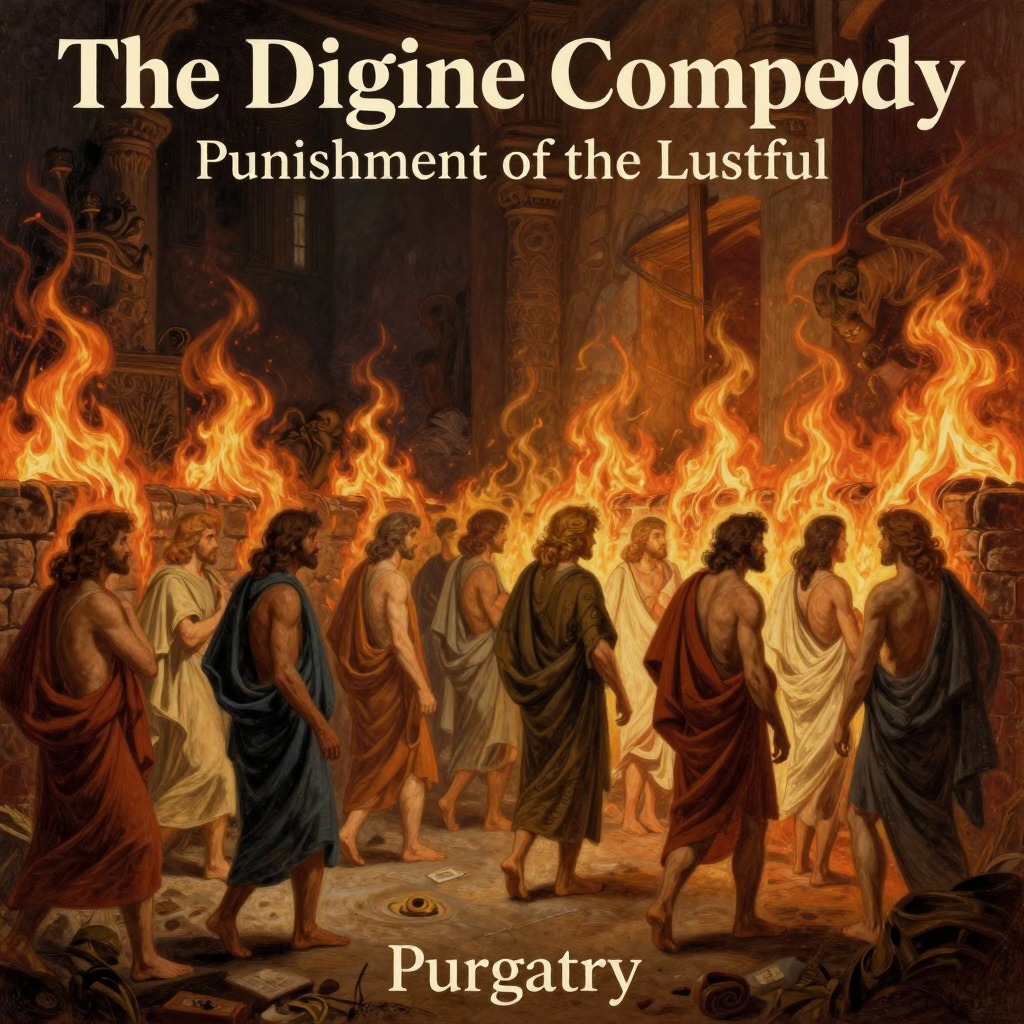
In the Purgatorio, the sin of lust — which includes both heterosexual and homosexual acts — is purged on the seventh and final terrace, the last of the seven deadly sins to be cleansed before the soul enters the Earthly Paradise. Here, the penitent souls walk through a wall of fire, singing hymns and crying out examples of chastity and of the punishment of lust. The fire burns them, but it does not destroy; rather, it purifies their desire, redirecting it toward God. The souls are divided into two groups: those who committed heterosexual lust and those who committed homosexual acts. The former cry out "Sodom and Gomorrah!" as they pass each other, while the latter cry out the name of Pasiphae, who lusted after a bull. The two groups kiss each other in a brief greeting, then continue on their way, weeping and singing. This is the final purification before the soul ascends to the Earthly Paradise, where it will drink from the waters of Lethe and Eunoe and be made ready for Heaven. The contrast between the eternal, sterile torment of the Inferno and the hopeful, cleansing fire of the Purgatorio is stark: in Hell, the sodomites run forever on burning sand, their desire never satisfied; in Purgatory, the lustful walk through fire with joy, knowing that their suffering will end and that they will be united with God.